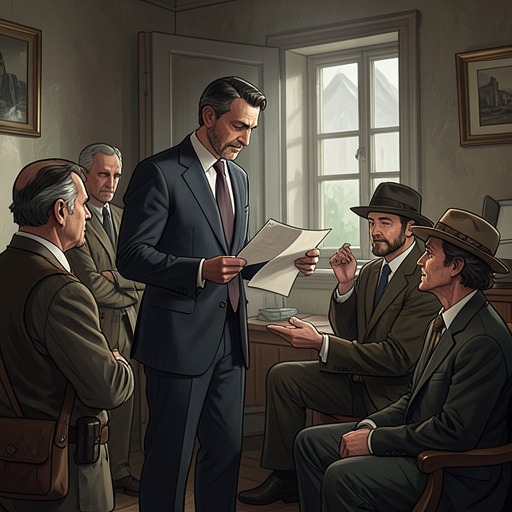
Ma insists on her version of “Ma Rainey’s Black Bottom”
Ma Rainey's Black BottomMa Rainey’s insistence on her version of Ma Rainey’s Black Bottom turns a dispute over arrangement into a contest over who has the authority to shape, perform, and profit from her music. When she discovers that the band has been rehearsing Levee Green’s version, she rejects it, names Sylvester Brown as the speaker for the introduction, and makes clear that the decision belongs to her. The episode pits Levee Green’s desire to remake the song against Ma Rainey’s control of her performance, while exposing how commercial decisions about Black music are negotiated through the unequal power of artists, managers, and a record-company owner.
The rehearsal Ma Rainey interrupts
Ma Rainey first hears the arrangement from the studio, where the band is already rehearsing Levee Green’s Black Bottom. Irvin describes its horn introduction and energetic arrangement as improvements that would excite listeners and give them music to dance to. His argument is practical and commercial: audiences want a sound that helps them forget their troubles. Ma Rainey refuses to treat that forecast as a reason to surrender the song. She says she dislikes Levee Green’s version and intends to sing it the old way, with Sylvester Brown providing the spoken introduction.
The conflict is not simply between an old arrangement and a new one. Irvin presents Levee Green’s work as a response to what listeners want; Ma Rainey answers that the song remains hers to perform on her own terms. When Irvin slips into speaking for a collective “we,” she challenges who that “we” represents. The exchange reveals a gap between the people making decisions about the recording and the singer whose name, voice, and authority are at stake. Her resistance blocks the proposed arrangement before it can become the session’s settled choice.
Ma Rainey sets the terms
Ma Rainey anchors her decision in her own judgment rather than a market prediction. She tells Irvin that she listens to her heart and to the voice within her, and directs him to tell Sturdyvant that Levee Green will not alter her song. She couples that artistic demand with a credible alternative: if the arrangement is unacceptable to Irvin and Sturdyvant, she can take her act back South on tour. Her impatience with Chicago gives the threat force, but the key point is that she presents recording as a choice, not an obligation that overrides her control.
She also asserts authority over the session’s timing. When Irvin says the group will be ready in fifteen minutes, Ma Rainey answers that they will be ready when she says they are. The order is enacted onstage: she exits the studio with Sylvester Brown, then enters the band room and introduces him to the musicians as her nephew and the person who will deliver the spoken opening in the old version. The movement between rooms carries her decision from argument into practice.
Levee Green’s competing claim
Levee Green objects as soon as Ma Rainey brings Sylvester Brown into the band room. He believes his arrangement lifts the song and places it before listeners with energy; he dismisses the older introduction as a form of tent-show performance that Northern audiences will not buy. In his view, the disagreement is about what the music can become and what listeners will accept, not simply about obedience to Ma Rainey.
Cutler makes the hierarchy explicit. He tells Levee Green that his role is to play what Ma Rainey wants, not to create or decide what the song should be. Levee Green threatens to quit, but Cutler answers that nobody will care if he does. The exchange sharpens the distinction between composition and performance within this band: Levee Green may contribute ideas, but Ma Rainey decides what version is sung. His creative ambition is real, yet it cannot by itself confer authority over her repertoire.
Change, history, and the power to choose
The dispute echoes the bandroom’s wider arguments about change. Toledo insists that everything changes, while Levee Green objects that he means visible changes such as the bandroom moving from upstairs to downstairs. Their disagreement gives the later fight over the song a broader resonance: change can be an abstract inevitability, but in the studio it is a choice made by particular people, with consequences for who gets heard. Irvin and Levee Green invoke changing tastes; Ma Rainey refuses to let that claim settle the matter for her.
Other bandroom exchanges connect musical authorship to the history of racial exploitation. Toledo’s stew metaphor describes Black people as leftovers from a history that has been consumed by white society, while Cutler’s account of Reverend Gates recounts a white mob forcing a minister to dance and destroying his cross and Bible. Cutler uses the story to argue that white people can use Black performers for profit without respecting who they are. These arguments do not erase the disagreement within the band; they make its stakes more pointed. Ma Rainey’s insistence is an assertion of agency within a recording business whose commercial priorities are not necessarily her own.
The decision’s later consequences
Ma Rainey’s defense of Sylvester Brown’s place in the session continues beyond the arrangement dispute. When Irvin reports that Sturdyvant proposes taking twenty-five dollars from Ma Rainey’s payment to pay the young man, she rejects the substitution: Sylvester Brown, she insists, must be paid in his own right, like the others. She tells Irvin that Sturdyvant must pay him or risk losing the chance to make another of her records. Sturdyvant eventually hands over two hundred dollars for Ma Rainey and twenty-five for Sylvester Brown.
Only after the money is secured does Ma Rainey sign the forms. She has Irvin send them to her address, then signs and warns that another mistake could send her records elsewhere. The later exchange shows the practical force behind the earlier stand: she does not control every commercial decision, but she can use her participation and future recordings as leverage. Her insistence on her own version of the song and her insistence that Sylvester Brown receive separate pay are distinct demands joined by the same refusal to let others decide what her contribution is worth.